.png?length=1000&name=Featured%20image%20(1).png)
The global coffee trade is a powerful economic engine, but one built on a fragile foundation. Smallholder farmers produce 80% of the world's coffee, supplying a global market that consumes over 2 billion cups every day. While this trade supports the livelihoods of approximately 25 million farmers, many continue to struggle with economic instability, disadvantaged by an opaque supply chain that obscures the actual value of their crop.
Driven by information asymmetry, the current coffee ecosystem structurally prevents these farmers from understanding the actual value of their product to the end customer. As Dubai and DMCC strengthen their role in global commodity trade, addressing this ‘value gap’ has become increasingly relevant to building a more transparent and sustainable coffee ecosystem.
Understanding the value gap between farmers and consumers
Coffee typically changes hands multiple times before reaching the final buyer. From local traders and exporters to importers, roasters, and distributors, value is added at each stage, often outside the country of origin. As a result, farmers rarely have insight into how their coffee is priced, marketed, or perceived at the point of consumption.
Because green coffee is usually exported early in the value chain, much of the downstream value generated through processing, branding, and distribution is captured by intermediaries rather than producers. Even as global coffee demand continues to grow, this structural imbalance has left many smallholder farmers vulnerable to price volatility and uneven income distribution.
 |
Garfield Kerr, President of the Specialty Coffee Association (SCA) and Founder of Mokha1450: “There’s a real disconnect between producing and consuming countries. Coffee might be sold two or three times before it reaches the consumer or the roaster, so farmers don’t really know its true value.” |
Pricing disconnect and limited market access
The value gap between producers and consumers is driven by a growing disconnect between the theoretical prices set by global commodity exchanges and the actual prices in the coffee trade. As these exchange prices are primarily driven by speculation rather than actual quality, they often undervalue the coffee crop before it even leaves the farm. Global commodity exchanges are no longer reliable for predicting prices, particularly in the backdrop of new and emerging trends.
This disconnect is especially pronounced in the specialty coffee market, where pricing is increasingly decoupling from standard global benchmarks. When the 'global price' is speculative and inaccurate, farmers negotiating based on these benchmarks face a disadvantage.
For ethical green coffee buyers, this means acknowledging the stock market price is a flawed indicator of value, as it fails to capture the true quality and effort that go into the product.
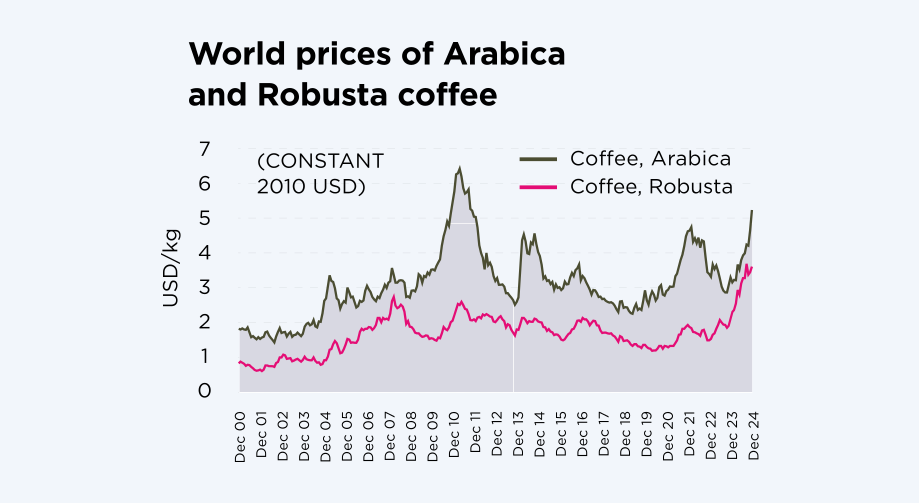
The prices of both Arabica and Robusta coffee have increased over the past 20 years, but the benefits have not been realised by coffee farmers.

Closing the gap through education and direct trade
Rebalancing the coffee trade requires more than price reform alone. It also depends on improving access to information, education, and markets for producers.
A significant shift is underway in the production regions, particularly in Africa. Traditionally focused on exports, African markets are now investing in local brands and processing capabilities to serve rising domestic consumption in urban centres. By retaining processing within the country of origin, producers can capture a larger share of the value chain.
Farmers are also gaining greater exposure through education and new tools to help assess their crops’ worth. The Specialty Coffee Association (SCA) has introduced the Coffee Value Assessment, an affordable system designed to assign value to coffee based on physical, descriptive, affective, and extrinsic attributes. When farmers can objectively score their own product, they gain the leverage needed to negotiate fair prices, moving the industry closer to truly ethical coffee standards.
DMCC’s role in supporting the coffee trade
DMCC’s Coffee Ecosystem brings together infrastructure and technology, designed to reduce friction in global coffee trade. Its Coffee Centre facilitates member introductions, enabling green coffee trade via its world-class facility in Dubai.
A key support initiative is the Tradeflow Platform, designed to assist producers and exporters in raising finance using coffee stored at the DMCC Coffee Centre as warranted collateral.
DMCC also works closely with producer organisations, including partnerships with the African Fine Coffees Association (AFCA). Through such collaborations, African coffee producers gain greater visibility, access to logistics options, and direct engagement with global buyers, supporting efforts to retain more value from exports.
Building the transparent and equitable coffee trade
Empowering the farmers responsible for almost 80% of the global supply to understand and negotiate their true worth can build a resilient coffee ecosystem. Closing the value gap will require a gradual shift away from opaque intermediaries and towards transparent, tech-enabled direct trade.
Through its coffee ecosystem, infrastructure, and strategic partnerships, DMCC is contributing to this transition, supporting a global coffee trade where transparency, traceability, and value recognition are embedded across the supply chain.