BLOG
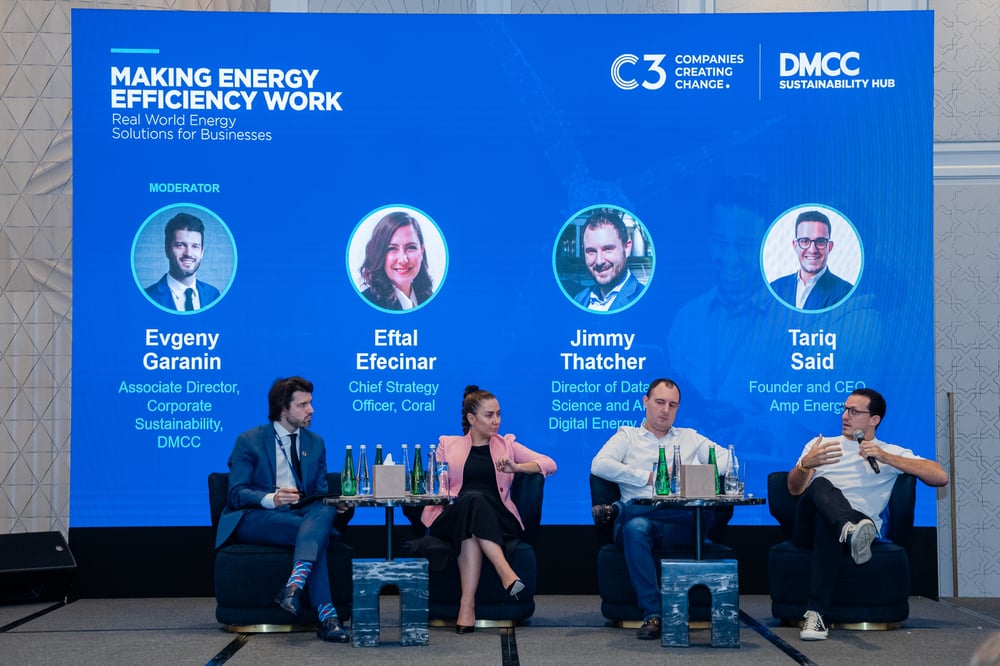
Artificial Intelligence is rapidly changing how the UAE generates, manages and optimises energy. During a recent DMCC Sustainability Hub panel discussion – hosted in partnership with UAE-based social enterprise C3 – industry leaders from Coral, Amp Energy and Digital Energy AI shared how intelligent technologies are reshaping carbon management, infrastructure performance and operational strategy across the energy sector.
The Efficiency Imperative: Automating Carbon Management
Eftal Efeçınar, Chief Strategy Officer at Coral AI, opened the discussion by highlighting a key operational challenge: organisations spend huge amounts of time gathering carbon data, yet struggle to turn it into action.
Coral’s AI-native platform by Coral has eliminated the need for manual audit teams by automating emissions tracking, materiality assessments and reduction planning. What once took seven people is now handled in real time, with tasks automatically allocated across departments.
Importantly, the technology is designed for non-experts, accelerating emissions reduction at lower cost. In a market such as the UAE – where the pace of transformation is shaped by the Net Zero 2050 commitment – solutions like this will be critical in supporting businesses to deliver operational impact.
Smarter Buildings Through IoT and AI
In the UAE, cooling can account for up to 70% of electricity use. Yet globally, only 10% of commercial buildings have reliable energy monitoring systems.
Tariq Said, CEO of Amp Energy, presented a building-agnostic IoT solution that delivers 99% data accuracy within hours of installation, offering equipment-level monitoring across HVAC, chillers, pumps and lighting.
The platform currently uses AI to generate 60% of its backend code – and is expected to reach 70% by year-end – making development faster and more scalable.
With a natural language interface that lets users “talk” to their building data, this solution makes energy optimisation more intuitive. In fast-growing cities like Dubai, AI + IoT is closing a major infrastructure gap and enabling buildings to become intelligent, adaptive systems.
AI in Energy Logistics: Strategy Over Automation
While AI is powerful, it’s not a magic button. Jimmy Thatcher of Digital Energy AI explained that AI shines in scenarios with complex variables – such as logistics planning and scenario modelling – but is less useful for simple, single-outcome processes.
One of his case studies showed AI-led optimisation reducing offshore vessel energy consumption by 30-40% – the equivalent of removing around 80,000 cars from the road.
However, Thatcher warned that up to 90% of AI projects fail due to poor planning. His solution: the use of controlled “sandbox” environments where organisations can test and refine AI tools before scaling.
Regional Innovation: The UAE’s Homegrown Energy Solutions
The discussion also highlighted how the UAE is evolving from adopter to creator of energy technology.
Yellow Door Energy, based in Dubai, has over USD 100 million in solar assets across the UAE, Saudi Arabia, Egypt and Jordan. By combining solar leasing with advanced monitoring tools, Yellow Door enables companies to adopt renewable energy without upfront cost.
FortyGuard, headquartered in Abu Dhabi, tackles the Urban Heat Island effect using AI-powered heat mapping, advanced materials and cooling strategies. Their solution can reduce urban temperatures by up to 10°C – critical in Gulf climates.
These examples demonstrate that the intersection of AI and energy is already operational, increasingly central to how businesses manage risk and performance, and actively being built in the region.
The Hybrid Approach: Humans and AI
The future of energy efficiency lies not in replacing professionals, but in equipping them with more powerful tools for analysis and action. Speakers agreed that while AI provides scale, pattern recognition and real-time insights, human expertise remains vital – especially in assessing complex variables such as building envelope performance, thermal bridging and infiltration.
In this regard, platforms like the DMCC Sustainability Hub play a critical role by connecting solutions providers, end-users and industry stakeholders.
Collaboration in Action: The Energy Sprint
The event concluded with an “Energy Sprint” workshop where professionals from facilities management, logistics, manufacturing and digital services worked together to map shared challenges and design technology roadmaps. By integrating technical insight with practical collaboration, the session underlined the need for shared frameworks that allow businesses to innovate while maintaining operational continuity.
DMCC’s Role at the Nexus of Innovation and the Energy Transition
As the UAE accelerates towards Net Zero by 2050, DMCC is enabling that transition – not only as a facilitator of business, but as a driver of innovation across sustainability, technology and trade.
Launched in 2024, the DMCC Sustainability Hub serves as a dedicated platform to help businesses embed ESG principles into their operations. It brings together global best practices, industry partnerships and cutting-edge tools – including access to AI-powered platforms, carbon assessment services and green financing pathways – to support meaningful climate action across sectors.
These efforts are underpinned by DMCC’s growing Energy Ecosystem, which now includes over 3,600 member companies operating across conventional and renewable segments. This makes it one of the largest and most diverse energy clusters in the region.
Through the Sustainability Hub and its broader ecosystem support, DMCC is enabling companies to scale clean energy solutions, adopt intelligent infrastructure and explore new business models that align with global sustainability trends.
By convening key stakeholders, accelerating implementation and aligning with national priorities, DMCC continues to position the UAE – and Dubai – as a global centre for sustainable energy innovation.