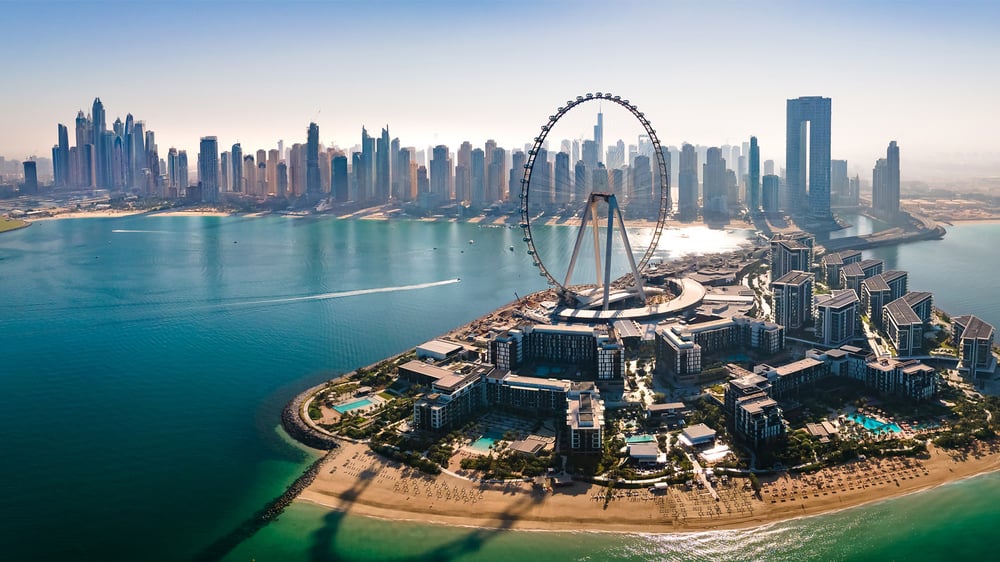
Living in Dubai means joining a city where residents come from more than 200 nationalities. Expatriates make up the majority of the UAE's population, drawn by year-round sunshine, tax-free salaries and a central position between Europe, Asia and Africa.
Moving to a new country is rarely simple, and the more you know before you arrive, the smoother the move will be. This guide covers what you need to know about life in Dubai, from safety and schools to visas, work and the cost of settling in.
Daily life in Dubai for expats
Now home to a population exceeding 4 million residents, Dubai's appeal is reflected in its high global standing.
Dubai was named the most competitive city in the Gulf by Oxford Economics' Global Cities Index 2025, scoring 77.1 out of 100 across measures of economic strength, human capital and liveability.
With its combination of year-round sun, coastal lifestyle, and extensive leisure options, the city offers an accessible environment for relocation.
What languages do they speak?
Arabic is the UAE’s official language and is used in legislation and government proceedings. English is widely used in business, tourism and day-to-day communication, while English translations of some official materials may also be available.
In practice, English and Arabic are widely used across business, public services and signage, alongside many other languages spoken by Dubai’s international population.
How safe is Dubai for expats?
Dubai consistently ranks highly in international safety perception indexes, while the UAE ranked fourth for safety and security in the 2026 InterNations Expat Insider survey.
With low crime and visible policing, it is also widely regarded as one of the safest cities for women, who make up a significant share of Dubai's expat workforce. In a 2025 Quality of Life Security Survey, 98.1% of women in the UAE said they feel safe walking alone after dark.
Is it expensive to live in Dubai?
Dubai's cost of living has risen in recent years, but it remains lower than most of the global cities it competes with, such as London, New York and Singapore. Housing is usually the largest expense, but tax-free salaries mean residents keep more of what they earn compared to other global hubs.
Housing is typically one of the largest household expenses for residents. Rent increases at renewal are capped by Dubai's tenancy rules and the Dubai's Smart Rental Index. It determines whether a rent increase is permitted at renewal and, where applicable, the maximum increase allowed.
One thing to plan for is how rent is paid. Rent payment schedules are agreed between the tenant and landlord and commonly range from one to four cheques, although some properties offer more frequent payment options.
Securing temporary accommodation initially can offer you a valuable window of time to explore Dubai's diverse residential districts. This strategy will enable you to discover an area that aligns with your lifestyle and budget.
Best schools in Dubai and higher education options
For families relocating with children, Dubai's education provision covers every stage. The city has 227 private schools serving 387,441 students across 17 different curricula, including the British IGCSE, Indian CBSE, International Baccalaureate, American and French systems. All private schools are regulated by the Knowledge and Human Development Authority (KHDA), which conducts inspections and monitoring visits to assess school quality, and under the Education 33 strategy, at least 100 new private schools are planned by 2033. With most pupils being expats themselves, children tend to settle in quickly.
In the 2024–25 academic year, Dubai had 41 private higher education institutions enrolling 42,026 students, while international student enrolment increased by 29% year on year. Most are international branch campuses of top-ranked universities.
How advanced is healthcare in Dubai?
Dubai's healthcare system is among the most developed in the region and is regulated by the Dubai Health Authority. In the 2026 InterNations Expat Insider survey, 85% of expatriates in the UAE rated the quality of medical care positively, while 84% gave positive ratings to its availability. Residents can access healthcare through public and private providers, subject to their insurance coverage and applicable eligibility requirements.
Many Dubai hospitals hold accreditation from Joint Commission International (JCI), an internationally recognised healthcare accreditation organisation.
Facilities are held to international standards, with many hospitals holding the global benchmark for patient safety. Care is delivered through a mix of public hospitals and a large network of private hospitals and clinics, which most expatriates use. Internationally affiliated providers include King's College Hospital London and Moorfields Eye Hospital, both UK branches, alongside American Hospital Dubai, a member of the Mayo Clinic Care Network, and Mediclinic, giving residents access to specialist care without travelling abroad.
Working in Dubai
Working in Dubai places you in one of the region's wealthiest and fastest-growing economies, and a city that has become a magnet for professionals looking to advance their careers. Dubai's economy is increasingly focused on technology and innovation, with heavy government investment positioning Dubai as a growing hub for start-ups alongside established firms in finance and trade.
Professionals who relocate to Dubai work across industries, and a growing number arrive to build freelance careers rather than join a single employer. In the 2026 InterNations Expat Insider survey, 80% of expatriates said moving to the UAE had improved their career opportunities, compared with 55% globally. Building the right connections also matters, and networking across Dubai's business community is often how newcomers find their first opportunities.
Because the UAE charges no personal income tax, gross salaries are take-home salaries, so most professionals keep more of what they earn than they would in an equivalent role elsewhere. This is one of the city's biggest practical draws for skilled workers.
What is a typical workday like?
Most private-sector employees work up to eight hours per day or 48 hours per week, although some employers operate shorter working weeks. During Ramadan, normal working hours are reduced by two hours per day. Similar to other countries, the weekend starts on Saturday and ends on Sunday.
As for the commute, getting around by car would be the easiest way to go around Dubai. Rush hour is from 7 to 10 AM and 4:30 to 7 PM. Journey times vary by location and can increase significantly during peak commuting periods.
How many public holidays are there in Dubai?
In Dubai, there are two types of public holidays: Fixed and Islamic. Dates for Islamic holidays are published each year, but are based on the lunar cycle, so the final dates can only be confirmed a day or so before they begin and only once the moon has been sighted. Therefore, the published dates may move very slightly.
|
Date |
Holiday |
Fixed / Islamic |
|
1 January |
New Year's Day |
Fixed |
|
19 March (3–4 days) |
Eid Al Fitr |
Islamic |
|
26–29 May |
Arafat Day and Eid Al Adha |
Islamic |
|
15–16 June |
Islamic New Year |
Islamic |
|
24–25 August |
Prophet Muhammad's Birthday |
Islamic |
|
1 December |
Commemoration Day |
Fixed |
|
2–3 December |
National Day |
Fixed |
The table above shows the confirmed and predicted public holidays for 2026. For an updated list of public holidays in the UAE, please refer to the Dubai Government Portal.
How do you typically travel to work?
Getting around Dubai is straightforward. Many residents drive, but the city also has a modern, integrated public transport network of metro, buses, trams and taxis run by the Roads and Transport Authority, all linked through a single Nol travel card.
Is Dubai still tax-free in 2026?
Largely, yes, though with one important change for businesses. There is still no personal income tax in the UAE, so salaries, wages and other personal earnings are not taxed, and your gross pay is your take-home pay.
What changed is corporate tax. The UAE has applied a 9% federal corporate tax on business profits above AED 375,000, with profits below that threshold taxed at 0% to support small businesses and start-ups. Free zone companies can still qualify for a 0% rate on qualifying income, provided they meet the conditions set by the authorities.
Individuals do not pay tax on their salaries, regardless of changes to corporate tax rates. However, if you remain a tax resident elsewhere while earning income in Dubai, your position may depend on your home country's tax residency rules and whether it has a double taxation agreement with the UAE.
How do you get a visa to work in Dubai?
The entry and residence process depends on the visa category. Employment visas are generally sponsored by an employer, while certain visit, Green Visa and Golden Visa routes do not require traditional employer sponsorship.
Residence and work authorisation procedures vary by visa category and are normally coordinated by the sponsoring employer, free-zone authority or relevant immigration authority. Your main task is to prepare your documents thoroughly. If you want to look for a job after moving to Dubai, the country also offers a jobseeker visit visa, valid for 60, 90, or 120 days, which allows skilled professionals and recent graduates to enter without a sponsor to attend interviews and explore the market.
If you set up a business in Dubai, you can obtain residency through an employment or investor visa, typically valid for 2 to 3 years. The UAE Golden Visa offers a 10-year residency for investors, entrepreneurs, and specialised professionals, and the Green Visa, a 5-year self-sponsored option for skilled workers and freelancers. Free-zone residence and employment processes are generally coordinated through the relevant free-zone authority and the General Directorate of Identity and Foreigners Affairs, subject to the applicable visa and employment requirements. It is important to note that holders of this type of visa will not be allowed to work outside free zones. The four types of free zone visa available at DMCC cover employment, partner/investor, business visitor and student categories.
The Dubai community
Dubai offers a wide range of activities and entertainment for families, individuals and children, from sporting events and festivals to dining, leisure and the outdoors.
Events
Dubai hosts a full calendar of annual events. On the sporting side, the DP World Tour Championship (golf), the Dubai Duty Free Tennis Championships and the Dubai 24 Hour endurance race at Dubai Autodrome draw international fields each year. The city is also known for large-scale festivals, including Dubai Design Week, Dubai Restaurant Week and the Dubai Shopping Festival.
Meals and food
Dubai's dining scene spans almost every cuisine. Alongside international options such as steakhouses, Turkish, Brazilian, and Chinese restaurants, the city is a great place to try regional dishes, including machboos, chelo kebab, and iranian sangak. Its reputation for quality is reflected in the MICHELIN Guide Dubai, which in its 2025 edition recognised 119 restaurants across more than 35 cuisines. Within DMCC's own community, JLT & Uptown Dubai have a thriving food scene, ranging from Levantine and Greek to Peruvian, hand-pulled noodles, and cult burger spots, with everything from casual cafés to MICHELIN-recognised dining.
For everyday shopping, major supermarket chains including Carrefour, Spinneys and Waitrose stock both imported and locally sourced goods. During Ramadan, opening hours and dining arrangements may change, although many restaurants continue to operate throughout the day.
Activities
Dubai's leisure options range from desert experiences such as camel riding and dune drives to indoor skiing at Ski Dubai in Mall of the Emirates. The city's infrastructure supports a wide range of sports and outdoor activities year-round.
JLT and Uptown Dubai – DMCC's award-winning communities
Jumeirah Lakes Towers (JLT) is one of Dubai's largest mixed-use communities, home to more than 100,000 people living and working in the area. Developed and managed by DMCC, it combines residential, commercial and retail space with extensive amenities, making it a practical base for both residents and businesses. Alongside it, Uptown Dubai is DMCC's second flagship district, anchored by Uptown Tower, bringing further residential, office, retail and hotel space to the area.
Dubai in summary
Dubai's appeal comes down to its people as much as its opportunities. With more than 200 nationalities living and working side by side, it is one of the most international cities in the world, and that mix is a large part of why so many expatriates choose to settle here.
If you're considering moving to Dubai to set up a business, DMCC can support. We offer the essential services you need to establish and grow your company. Book a consultation to find out more.
.jpg?width=600&name=shutterstock_610437719%20(2).jpg)
