
Dubai has established a defined regulatory framework for businesses operating across crypto, blockchain and virtual assets. For founders, one of the first questions is therefore not simply where to establish a business, but what activity the company intends to conduct and which regulatory requirements apply.
VARA regulates virtual asset activities in and from Dubai, excluding DIFC, while DMCC provides commercial company formation, licensing and sector support through the DMCC Crypto Centre. Where a proposed activity falls within VARA’s regulatory perimeter, the appropriate VARA authorisation or approval is required before the relevant regulated virtual asset activity can begin.
Understanding that distinction is an important first step for any crypto, blockchain or Web3 business considering setup in Dubai.
What are the roles of DMCC and VARA?
DMCC and VARA perform distinct functions.
DMCC provides the commercial framework, including company incorporation, the relevant commercial licence, workspace and ongoing services for member companies.
VARA provides the virtual asset regulatory framework. It determines whether a proposed activity falls within its regulatory perimeter and grants the applicable regulatory authorisation.
Holding a DMCC commercial licence does not, by itself, authorise a company to conduct a regulated virtual asset activity.
Which crypto activities require VARA authorisation?
VARA currently identifies eight regulated virtual asset activities:
- Advisory Services
- Broker-Dealer Services
- Custody Services
- Exchange Services
- Lending and Borrowing Services
- Management and Investment Services
- Transfer and Settlement Services
- Category 1 VA Issuance
Businesses seeking to conduct regulated virtual asset activities in or from Dubai must obtain the relevant VARA licence or authorisation before commencing regulated operations.
What about proprietary trading?
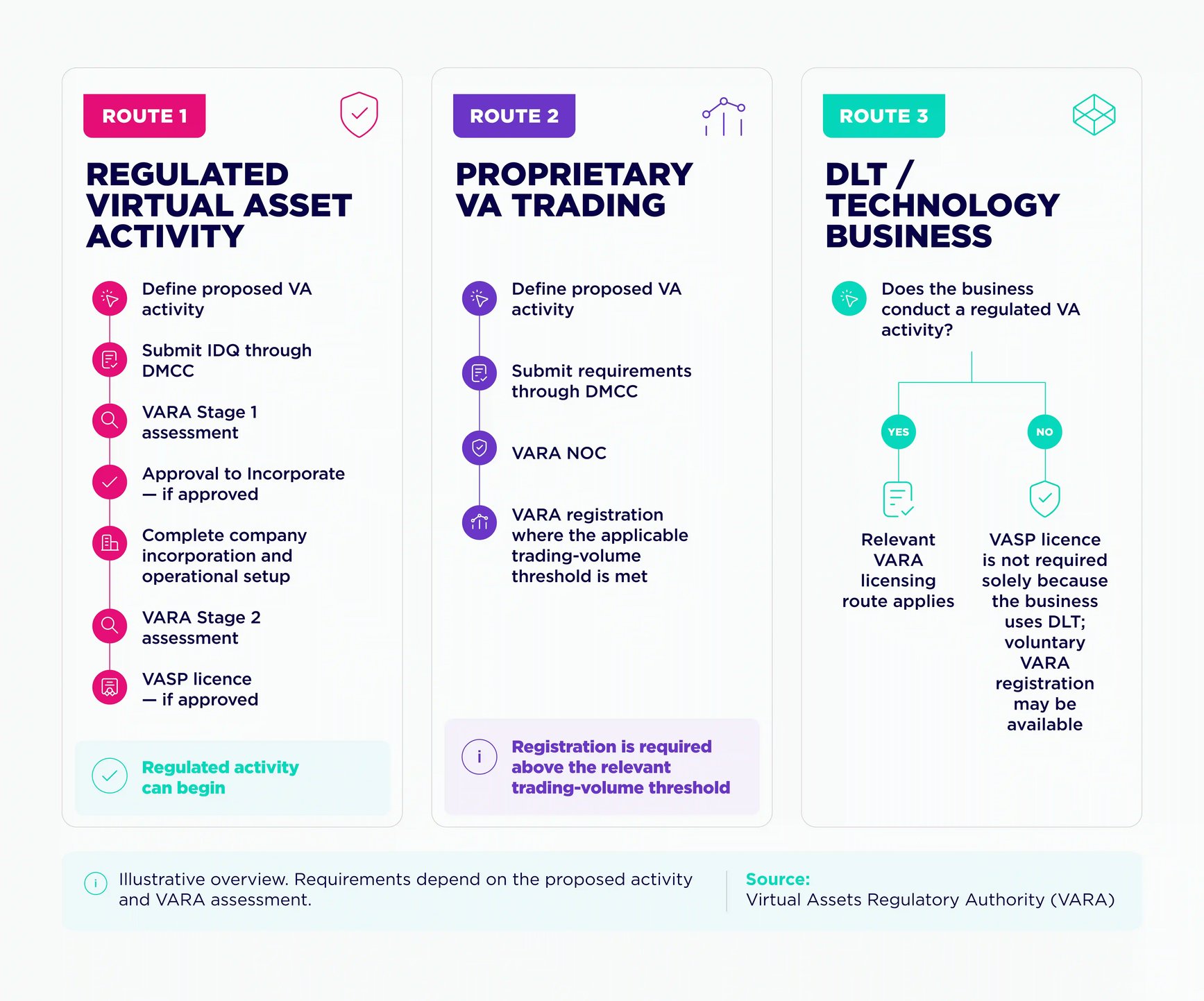
A company trading virtual assets using only its own funds, without providing the activity as a service to clients, does not require VASP licence for proprietary trading. However, VARA requires a No Objection Certificate (NOC), and registration is mandatory where trading exceeds AED 1 billion over a 30-day rolling period.
What about blockchain and DLT businesses?
A blockchain or Distributed Ledger Technology business does not automatically fall within VARA's regulated perimeter simply because it operates in the sector.
The determining factor is the activity being conducted. A DLT provider that does not carry out a regulated Virtual Asset Activity is not required to hold a VASP licence. Instead, a one-time No Objection Certificate from VARA is obtained following licence issuance, confirming that the activity sits outside the regulated perimeter.
How does the VARA licensing process work?
New VASP applicants follow a two-stage VARA process.
Stage 1: Approval to Incorporate
Applicants submit an Initial Disclosure Questionnaire through DMCC or another relevant Dubai commercial licensor, together with required information on the proposed business, beneficial owners and senior management.
If approved, VARA issues an Approval to Incorporate (ATI), allowing the applicant to finalise legal incorporation and prepare its operations. The company cannot conduct regulated virtual asset activities at this stage.
Stage 2: VASP licence
The applicant then completes VARA's full licensing assessment and provides the required regulatory documentation.
Regulated virtual asset activities can begin only once VARA has issued the relevant VASP licence, subject to any conditions attached to it.
What compliance requirements and costs apply?
VARA-licensed VASPs must comply with four compulsory rulebooks covering company requirements, compliance and risk management, technology and information, and market conduct. Activity-specific rulebooks also apply according to the services the VASP is authorised to provide. The current versions of the four compulsory rulebooks are effective from 19 June 2025.
For non-regulated activities, the DMCC Crypto Centre Package starts at AED 31,000, subject to applicable terms and conditions. Regulated activities, however, follow standard DMCC licensing fees.
For regulated VASPs, VARA charges separate fees. Licence application fees currently range from AED 40,000 to AED 100,000 for one regulated activity, while annual supervision fees range from AED 80,000 to AED 200,000 per regulated activity, depending on the activity. Additional regulatory fees can apply where further activities are added.
Why does crypto regulation matter to the future of trade?
DMCC has been examining the relationship between digital assets, finance and global trade for several years.
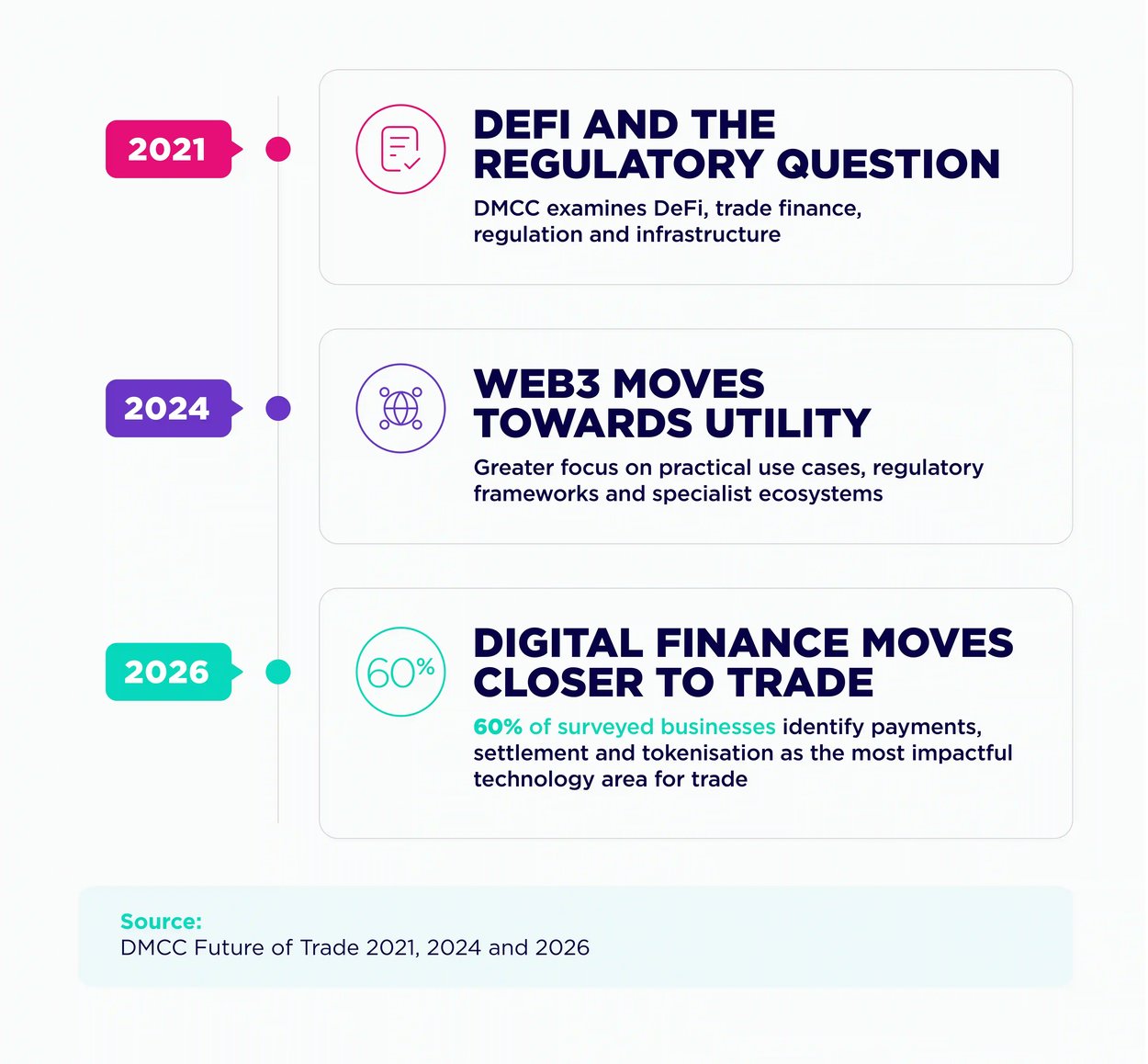
Its 2021 Future of Trade Special Crypto Edition, Perspectives on Decentralised Finance, examined DeFi, trade finance and the challenge of developing regulation while new blockchain-based models were still emerging.
The 2024 Special Web3 Edition, Digital Decentralisation: Crypto, DeFi and the Metaverse, reflected an industry increasingly focused on practical use cases, regulatory frameworks and specialist sector ecosystems.
That discussion has moved further in The Future of Trade 2026: Rebuilding Through Rupture. The report identifies a new generation of financial infrastructure taking shape around stablecoins, tokenisation and wholesale CBDCs. It also finds that 60% of businesses surveyed identify payments, settlement and tokenisation as the most impactful technology area for trade.
For virtual asset businesses, this creates a wider commercial context for regulation. As digital assets become more relevant to cross-border payments, settlement and tokenised assets, clarity around regulated activities and authorisations becomes increasingly important.
"Stablecoins, tokenisation and wholesale central bank digital currencies are beginning to support faster and more flexible settlement in certain corridors."
Feryal Ahmadi, Deputy CEO and Chief Operating Officer, DMCC
What does the DMCC Crypto Centre provide?
DMCC Crypto Centre grew to more than 800 member companies by the end of 2025, with 180 new companies joining during the year.
Alongside commercial licensing and workspace, DMCC's Crypto and Blockchain ecosystem provides access to specialist service providers across areas including legal, regulatory and compliance, tax, accounting and auditing, banking and company structuring. It also includes accelerator programmes and industry partners across the Web3 sector.
For founders, this means the commercial setup process can sit alongside a sector-focused business community, while VARA remains responsible for the regulatory authorisations required for regulated virtual asset activities.
FAQs on Crypto Regulation in Dubai









.jpg?width=600&name=design.oxygen_Hyperrealistic_professional_photography_wide_sh_62ed0d0a-3916-487f-9a33-329553e4a5b8_2%201%20(2).jpg)