Dubai has become one of the world's most established destinations for international business, drawing entrepreneurs, investors, and multinationals from across the globe. Its appeal extends beyond geography: connectivity to major global markets, a business-friendly regulatory framework, and access to one of the world's most diverse commercial ecosystems. From trade and technology to professional services and manufacturing, companies can build and scale from Dubai while serving customers across the Middle East, Africa, Asia, and Europe.
Recent developments have reinforced that position. The UAE continues to expand its international trade relationships, attract foreign investment, and align its regulatory framework with global standards. Digital formation processes and free zone structures have made it easier than ever for international founders to establish and manage businesses from anywhere in the world.
For founders considering where to launch or expand, the decision goes beyond immediate market access. It is about where to build for the long term. This guide explores the factors that continue to make Dubai a compelling base, from connectivity and regulation to infrastructure and remote setup.
Why do entrepreneurs choose Dubai for business setup and expansion?
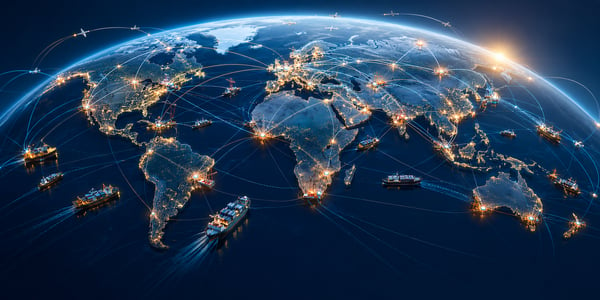
Dubai sits within reach of major markets across Europe, South Asia, the Middle East, and East Africa. Aviation, sea, and overland networks connect to all of them, with multiple ports and corridors keeping each route active. A Dubai-based company operates at the intersection of several active trade flows.
The connectivity is real. Dubai International Airport handled a record 95.2 million passengers in 2025, the highest annual international passenger traffic ever recorded by an airport. Combined with one of the region's most active international shipping networks, the city operates at a logistics scale built for international businesses from day one.
China–UAE non-oil trade reached a record USD 111.5 billion in 2025, up 24.5% year on year. China remains the UAE's largest trading partner, while DMCC is home to more than 1,000 Chinese companies. Together, these figures reflect the depth of commercial links between the UAE and one of the world’s largest trading economies.
Dubai's business-friendly regulatory and tax environment
The UAE operates a business-friendly tax framework with a 0% personal income tax rate. Qualifying Dubai free zone entities also benefit from a 0% corporate income tax rate. For international investors weighing where to set up, that baseline is a significant part of the location decision.
Dubai's free zone framework provides additional advantages for international investors, including 100% foreign ownership and the ability to repatriate capital and profits, subject to applicable laws and regulations.
The UAE has also continued to strengthen its regulatory framework in line with international anti-money-laundering and counter-terrorist-financing standards. FATF removed the UAE from its list of jurisdictions under increased monitoring in February 2024, and the European Union subsequently removed the UAE from its list of high-risk third countries in 2025.
Within this environment, DMCC applies its own company-registration, due-diligence and compliance requirements as part of the onboarding process. Operating since 2002, DMCC provides an established free zone framework for international businesses setting up and operating in Dubai.
How does Dubai's trade infrastructure support global operations?
A business location is defined by the systems behind it. Dubai's trade infrastructure operates across physical, financial, and digital layers. Each plays a distinct role in supporting trade and business activity.
Physical trade infrastructure
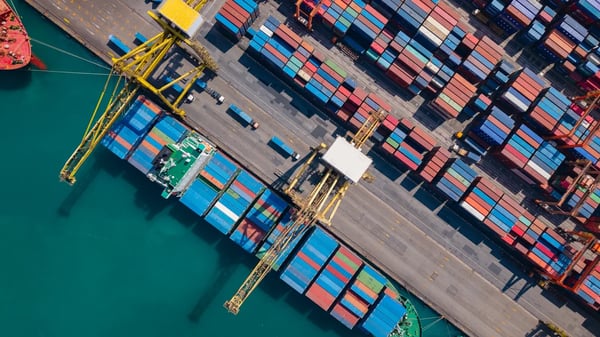
Beyond the airport and ports already mentioned, Dubai's free zone infrastructure allows goods to move duty-free until they are released into the local market, making it well-suited to businesses managing regional distribution rather than just point-to-point trade.
Financial infrastructure
Trade financing, international banking, and Dubai's regulated financial frameworks enable capital and instruments to move at the speed the business needs, regardless of how goods move on any given day.
Digital infrastructure
Virtual warehousing, digital cargo tracking, and online trade platforms enable cross-border inventory management without physical infrastructure across every market a company serves. Many business functions can now be managed digitally rather than through a physical presence.
Within this environment, DMCC provides businesses with access to Dubai's wider trade, technology, and professional services through a free zone framework designed for international companies.
Can you set up and run a business in Dubai remotely?
For international businesses, the ability to operate across markets and time zones without a constant physical presence is increasingly important. Dubai’s digital business infrastructure supports this, with many company formation and administration processes available online.
Many licensing, document submission and company administration requirements can now be completed digitally, reducing the need for founders to be physically present during setup and ongoing operations. Some processes, including banking, immigration and certain regulated activities, may still require in-person steps or additional approvals.
Setting up your Dubai business remotely
Within that model, formation at DMCC runs entirely through the DMCC Member Portal. For most licence activities, the application, document submission, identity verification, and licence issuance process can be completed online, with the process typically taking 7 to 10 working days. Banking, visa processing, and Emirates ID registration may require a short visit to the UAE, which most founders complete in a single trip once the licence is issued. It is important to note that the opening of a bank account remains subject to the bank's compliance review and final approval.
When your business is ready for a physical presence
Flexible property solutions in Jumeirah Lakes Towers and Uptown Dubai are available when the business calls for it, including flexi-desks, serviced offices, co-working, and physical office spaces. The same principle extends to residency: UAE residency is available through company formation in DMCC, with no employer sponsorship required, preserving the right to be in Dubai only when the business needs it.
The long-term outlook for doing business in Dubai
Dubai's longer-term development is supported by the Dubai 2040 Urban Master Plan, which sets priorities across infrastructure, mobility, economic activity, urban centres and quality of life.
Diversification reinforces that picture. Dubai's economy spans finance, technology, trade, logistics, and professional services, reducing exposure to any single sector or commodity.
The clearest evidence of how that long-term commitment plays out is in the free zones themselves. DMCC is now home to 26,000+ companies across 180+ countries and aysa That growth reflects how international businesses respond when a city is built for them to stay.
Setting up your business in Dubai
For entrepreneurs and investors evaluating where to establish a business, Dubai offers a combination of market access, infrastructure, regulatory clarity, and digital company formation that supports long-term growth. As international trade and investment continue to evolve, these fundamentals remain central to Dubai's position as a global business destination.
FAQs on long-term stability in Dubai