The global energy transition is changing more than how the world produces and consumes energy. It is changing where investment goes, where supply chains are built and which countries control the infrastructure behind them.
DMCC’s Future of Trade 2026 report finds that energy security is now shaping the transition alongside climate goals. This is creating new competition around clean-tech manufacturing, critical minerals, grids and energy infrastructure.
The result is a more complex energy landscape, in which competitiveness is increasingly defined by who can finance, manufacture, process, connect and power the technologies behind the transition.
Investment is moving towards the new energy system
Energy-transition investment reached a record $2.3 trillion globally in 2025, up 8% from 2024. For the first time, investment in the electricity sector was around 50% higher than capital deployed across hydrocarbon supply.
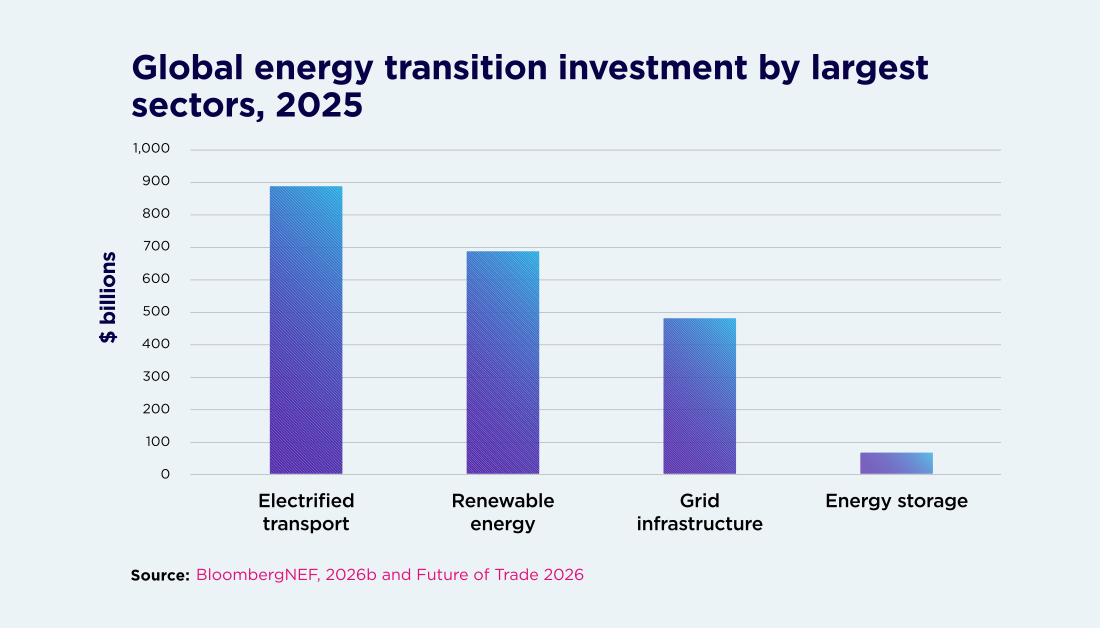
But the investment is not evenly distributed.
Asia Pacific accounts for almost half of global energy-transition capital, with China alone investing $800 billion in 2025, compared with $455 billion in the EU and $378 billion in the US.
This is where energy transition becomes a trade story. The countries building manufacturing capacity, securing inputs and developing infrastructure today will have a stronger position in the supply chains that support tomorrow’s energy system.
China’s advantage extends beyond energy production
China’s position is particularly significant because it has built capacity across several parts of the clean-tech supply chain.
It now controls more than 70% of global manufacturing capacity across major clean-tech segments, giving it a strong position across the technologies that will underpin the next phase of energy trade.
This matters because the transition is not only about producing cleaner energy. It is also about manufacturing the components, processing the materials and building the infrastructure that make that energy system possible.
“Now that there’s an energy security crisis, everyone’s going to be trying to look for alternative energies, whether it’s solar or wind or nuclear or fusion. And China is the leader in solar and wind technology, which means that I anticipate that we’ll see more of that being exported out of China and more countries will become more dependent on China when it comes to sourcing very quick and alternative sources of energy.”
Michelle Brouhard, Head of Policy and Geopolitical Risk at Kpler
Critical minerals are the hidden pressure points
The next challenge lies further down the supply chain.
Critical minerals such as lithium, cobalt, copper, nickel, graphite and rare earths are essential to EVs, batteries, wind turbines, solar panels and electricity grids.
Future of Trade 2026 notes that demand from clean energy technologies alone is projected to rise two to four times by 2040. Lithium demand could increase 51 times, while cobalt and graphite demand could rise up to 30 times, depending on how battery technology develops. Yet it takes an average of 16 years to move from mineral discovery to production.
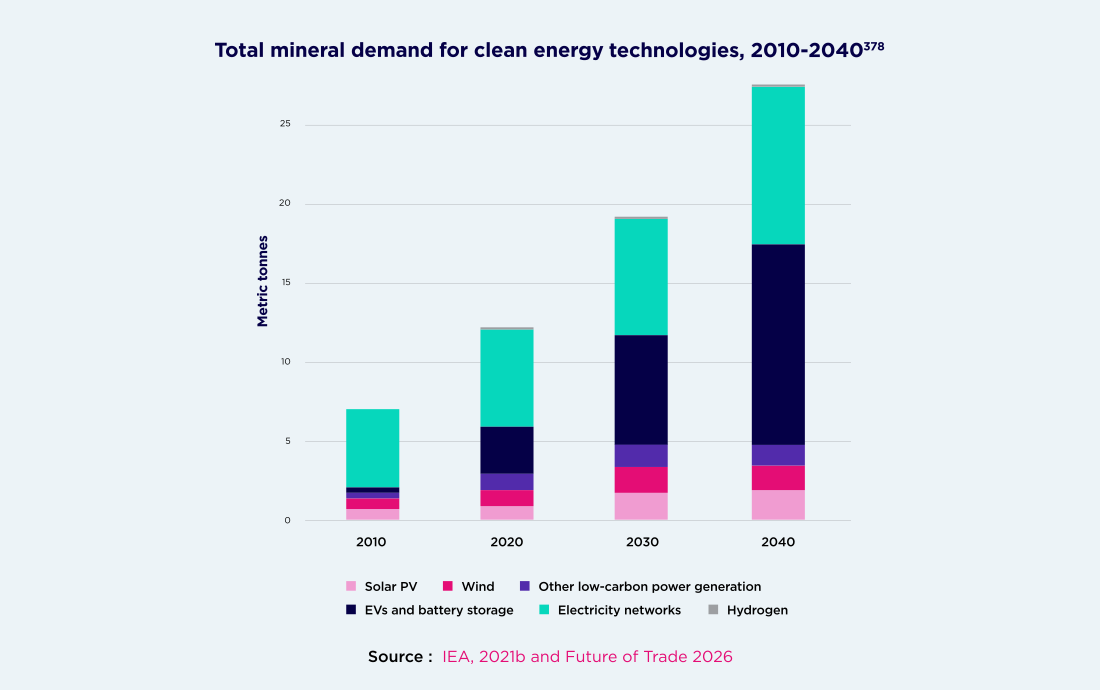
The issue is not only access to minerals. It is also where they are processed. China leads refining for 19 of 20 strategic minerals tracked by the IEA, making refining capacity an important point of concentration in global supply chains.
For businesses, this makes supply-chain visibility increasingly important. Knowing where minerals are sourced is no longer enough. Businesses also need to understand where they are refined, how dependent the process is on one market, and how exposed that process may be to export controls, tariffs or disruption.
Middle powers are becoming diversification hubs
As clean-tech supply chains become more concentrated in some areas and more diversified in others, middle powers are taking on a new role.
The report notes that GCC countries had invested more than USD 37.7 billion in around 62.9 GW of renewable energy projects as of October 2025. It also highlights how Gulf sovereign wealth funds are already deploying long-term capital into renewable energy, hydrogen, critical minerals and green industrial manufacturing.
This matters because diversification is not simply about finding another supplier.
It is about building alternative routes, processing capacity, investment partnerships and commercial connections that can reduce exposure to a single geography.
For businesses, locations with strong commodity infrastructure, capital access and links across multiple regions can become increasingly important as clean-energy supply chains expand.
The grid could become the bottleneck
More clean energy and electrification also mean significantly more demand for electricity.
Electricity demand from EVs alone could reach four times today’s level by 2030, while AI and data centres add another major source of demand. The report notes that forecasts indicate that annual electricity demand growth over the next five years could be 50% higher, on average, than annual additions over the previous decade.
Yet infrastructure is struggling to keep pace.
1,700 GW of renewable energy projects across European countries were waiting for grid connections in 2025.
A site may be attractive on paper, but if the grid cannot support future demand, the business case changes.
What businesses should watch
The energy transition is about more than moving from fossil fuels to cleaner alternatives. It is about who controls the inputs, who can manufacture at scale, who has reliable power infrastructure and who can connect fragmented supply chains.
For businesses, priorities follow from these findings:
- Map clean-tech dependencies across the full supply chain, including refining.
- Assess grid capacity and connection timelines before committing to new locations.
- Identify single-country exposure and determine where dual sourcing may be needed.
- Factor energy availability, grid reliability, connection timelines and power costs into location decisions.
- Build stronger regional partnerships. As clean-tech supply chains expand, access to alternative routes, trusted partners and connected ecosystems will become more important.
DMCC’s Energy Ecosystem brings together more than 3,600 member companies across traditional and renewable energy, supporting businesses operating across a changing global energy landscape. Its Energy Club also provides a platform for industry connections, knowledge sharing and sector discussion.
The energy transition is no longer only a climate story, but also about industrial capacity, supply-chain control, power infrastructure and energy security.
For businesses, the key question is not only which technologies will define the next energy economy. It is where the capacity, inputs and infrastructure behind those technologies will be built.





.jpg?width=600&name=design.oxygen_Hyperrealistic_professional_photography_wide_sh_62ed0d0a-3916-487f-9a33-329553e4a5b8_2%201%20(2).jpg)