For decades, many companies operated within a relatively predictable global trade system. Multilateral institutions set the rules. Supply chains stretched across continents. Efficiency became the dominant business objective. Companies sourced from the most cost-effective markets, produced at scale and relied on stable trade relationships to move goods, services and capital around the world.
That model still matters. But it no longer works on its own.
Geopolitical tensions, tariffs, regional conflicts, technology competition and supply chain disruptions have exposed the vulnerabilities of a highly interconnected trading system. Businesses are now operating in a world where resilience matters as much as efficiency, and where access, connectivity and adaptability have become critical advantages.
The old model was built for efficiency. The new one is built for resilience.
Globalisation was built on a rules-based trading system
Institutions such as the World Trade Organization provided common frameworks, reduced trade barriers and created greater certainty for businesses operating across borders.
Today, that certainty is becoming harder to find. The WTO’s Appellate Body remains defunct. WTO members failed to renew the long-standing e-commerce moratorium at the March 2026 Ministerial, marking the first failure since 1998. Governments are also increasingly using tariffs, industrial policy and trade restrictions to protect strategic industries and national interests.
At the same time, bilateral agreements, regional trade blocs and middle powers are playing a larger role in shaping international trade. Trade rules are becoming less universal and increasingly regional.
For businesses, this means navigating a world where policy shifts, geopolitical tensions and supply chain disruptions can reshape markets quickly.
The shift is visible in the data.
This does not mean global trade is collapsing. It means the assumptions behind global trade are changing.
As Deborah Elms of the Hinrich Foundation explains, the structures that governed trade for decades are weakening, raising new questions about what comes next.
DMCC’s Future of Trade 2026 report identifies the forces shaping global trade over the next two to three years:
1. Regional trade corridors are driving the next phase of growth
One of the clearest signs of change is the rise of South-South trade.
Trade between developing economies now accounts for 35% of global trade, surpassing North-North flows. This reflects deeper links across Asia, Africa, the Middle East and Latin America, supported by regional frameworks such as RCEP and AfCFTA.
35%
of global trade now takes place between developing economies
Source: Brookings Institution, 2023
This matters because future growth may not come from the same corridors that powered the last phase of globalisation.
For businesses, the question is no longer only:
“Where can we produce most efficiently?”
It is also:
“Where is demand growing, where are trade relationships deepening, and which corridors will matter next?”
Companies that remain focused only on traditional advanced-economy markets risk missing one of the most important shifts in global trade geography.
2. Middle powers are becoming the new trade connectors
As the trade system becomes more fragmented, middle powers are becoming more valuable.
Countries such as the UAE, India, Singapore and Vietnam are gaining influence because they can connect businesses across regions, trade networks and political blocs. Their advantage lies in more than geography. It lies in access, infrastructure, neutrality, logistics, financial connectivity and the ability to operate across different markets.
This is especially important in a world where companies are trying to avoid overdependence on any single country, bloc or supply route.
For businesses, middle powers can offer what the next trade era increasingly demands: access across multiple markets, stronger regional connectivity and more resilient routes to growth.
Dubai’s position between East and West gives it a natural role in this environment. Its connectivity, infrastructure and global business networks help companies reach growth markets across the Middle East, Africa, Asia and beyond.
Through DMCC, businesses can access a global community of 26,000+ companies, sector-focused ecosystems and international networks that support trade across regions and industries.
In the next phase of trade, connectivity will not just be a location advantage. It will be a strategic advantage.
3. Supply chains are moving from “just in time” to “built for disruption”
Supply chains sit at the centre of the new trade architecture. For years, businesses built supply chains around cost and speed. The goal was to reduce inventory, concentrate production and optimise every stage of the process.
That approach created efficiency. It also created vulnerability.
Geopolitical tensions, tariffs, export controls, critical mineral concentration and disruptions to major shipping routes have shown how quickly supply chain risk can become business risk.
This is why companies are shifting from “China + 1” to “China + many”.
The objective is not to remove China from global supply chains. It is to reduce exposure to single-country sourcing and build more flexible, multi-nodal networks.
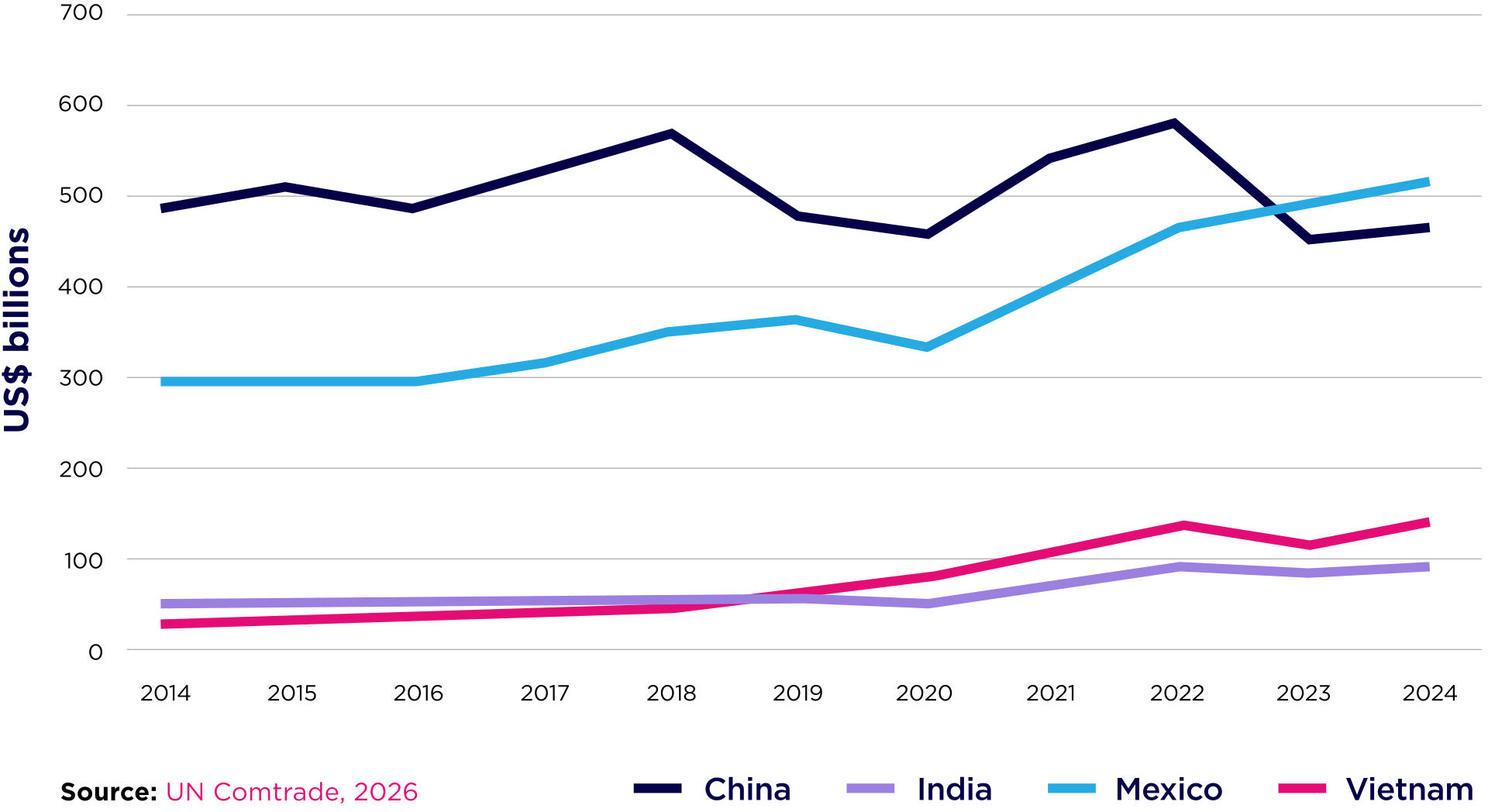
This shift is already visible. Between 2014 and 2024, U.S. imports from China contracted by 5%, while imports from Mexico, India and Vietnam rose sharply over the same period.
U.S. goods imports from select partners, 2014-2024
For business leaders, the lesson is clear: diversification is no longer a one-off reaction to disruption. It is becoming a continuous operating discipline.
That means identifying alternative suppliers before disruption occurs. It means understanding tariff exposure across routes. It means mapping dependencies beyond tier-one suppliers. It means treating resilience as an investment, not only a cost.
The companies that build flexibility early will be better positioned when the next disruption arrives.
4. AI and digital goods are changing the composition of global trade
Global trade is not only being reshaped by where goods move. It is also being reshaped by what is being traded.
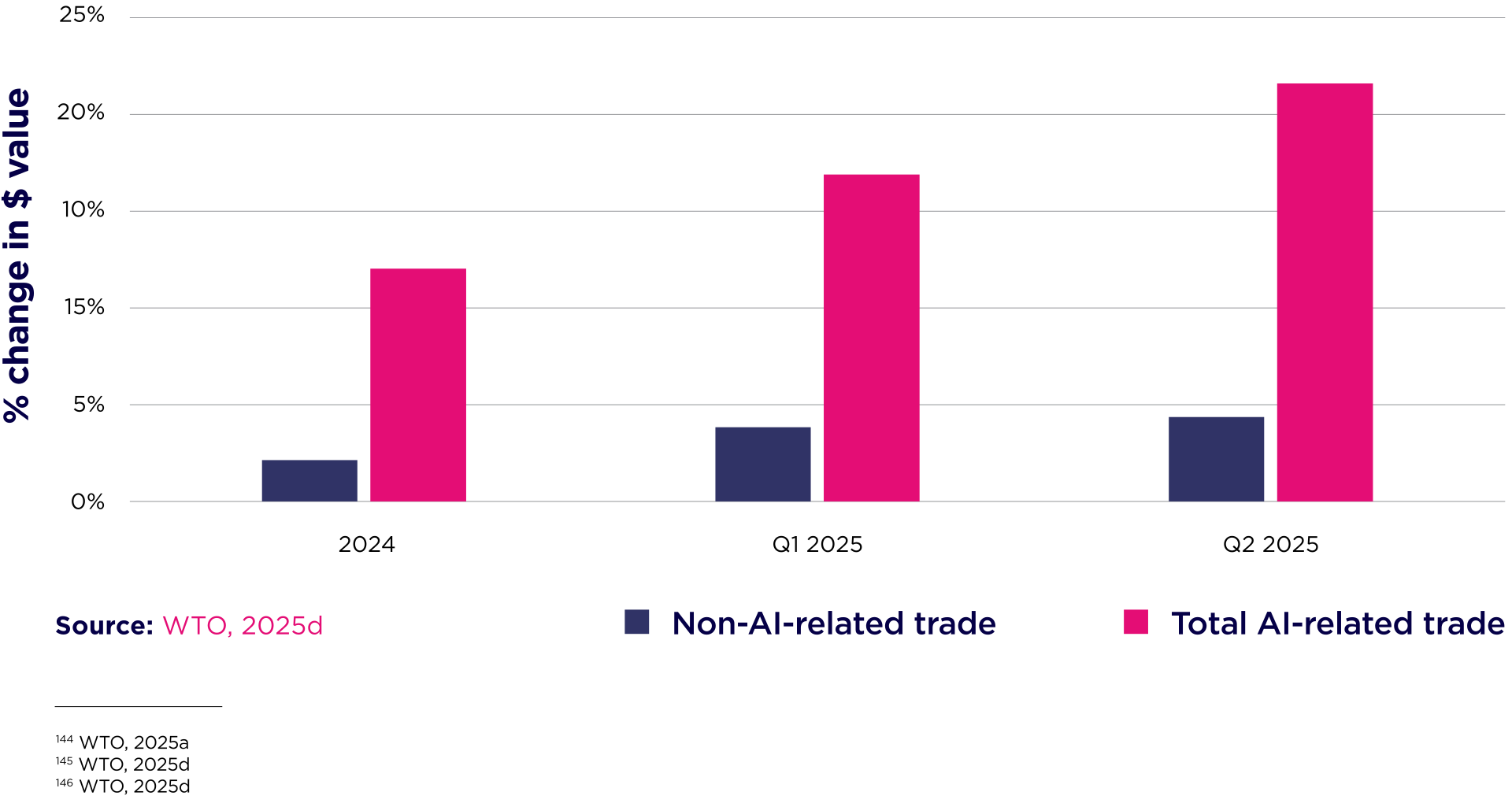
AI-related goods, including semiconductors, processors, servers and data centre hardware, drove 43% of global trade growth in the first half of 2025, despite representing 15% of global trade by volume.
AI-related trade growth far outpaces non-AI related trade
Services and digitally delivered trade are also becoming more important. Data flows, cloud infrastructure, digital platforms and AI adoption are becoming central to how trade moves and how value is created.
This changes the trade conversation.
Tariffs and shipping routes still matter. But so do data rules, digital infrastructure, AI capability, electronic documentation and payment systems.
The next trade advantage may not come from geography alone. It may come from the ability to combine physical trade infrastructure with digital capability.
Businesses that can move goods, data and capital efficiently may be better positioned than those relying on fragmented systems, manual processes and legacy infrastructure.
5. Financial infrastructure is becoming a competitive advantage
Trade depends on trust, documentation and settlement. That remains a major challenge.
The global trade finance gap remains at around USD 2.5 trillion, limiting access for SMEs and exporters in developing economies. More than 90% of trade transactions are still paper-based, creating friction across documentation, verification and settlement.
This slows transactions, raises costs and limits participation in cross-border trade.
New financial infrastructure may help address some of this friction. Stablecoins, tokenisation, electronic bills of lading and wholesale central bank digital currencies are moving from proof of concept towards live deployment in selected corridors.
These tools will not replace the global trade finance system overnight. But they are part of a wider shift towards faster, more accessible and more digital trade infrastructure.
For businesses, financial capability may become as important as logistics capability.
The ability to access finance, settle quickly and reduce documentation friction could become a meaningful source of competitiveness.
6. Connected ecosystems are becoming part of the new trade infrastructure
The next phase of trade will require more than a good product and a low-cost supplier.
Businesses will need access to markets, financing, talent, technology, logistics, regulatory support, sector expertise and trusted partners.
That is why connected business ecosystems are becoming more important.
A trade hub is no longer just a place where companies register or move goods. It is a platform that helps businesses reduce friction, build partnerships and reach new markets.
In a more fragmented world, ecosystems can help companies connect across regions, support diversification, access sector-specific networks and adapt when trade rules, supply chains or market conditions change.
For DMCC, this is where the report’s findings connect directly to its role as a global business district. Its community of 26,000+ companies, sector-focused ecosystems and position in Dubai give businesses access to the networks and infrastructure needed to operate in a more complex trade environment.
As trade becomes more complex, connected ecosystems are becoming part of the infrastructure businesses need to grow across borders.
What businesses should do now
The next phase of global trade will not reward companies waiting for the old system to return. It will reward those building for a world that is more regional, more digital, more relationship-led and more exposed to disruption.
Business leaders should be asking:
- Are our supply chains diversified?
- Do we have access to multiple markets?
- Are we investing in digital capabilities?
- Can we respond quickly to regulatory or geopolitical changes?
- Are we operating within the right business ecosystem for growth?
The businesses that answer these questions early will be better prepared for the trade system now taking shape, as the next era of trade can open new routes to growth.
The old model of globalisation was built around scale, efficiency and a broadly shared rulebook. The next model is being built around resilience, regional networks, strategic connectivity, digital capability, financial infrastructure and trusted ecosystems.
It is more complex. But it is also full of opportunity.






.jpg?width=600&name=design.oxygen_Hyperrealistic_professional_photography_wide_sh_62ed0d0a-3916-487f-9a33-329553e4a5b8_2%201%20(2).jpg)