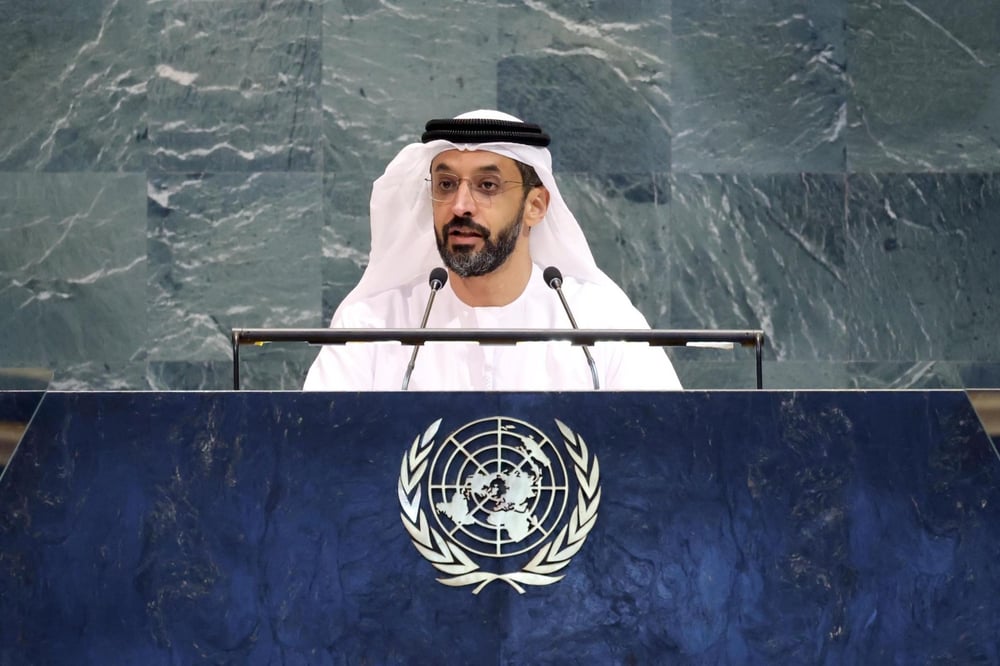
- Ahmed Bin Sulayem, Custodian Chair of the Kimberley Process in 2025, delivered an update on the UAE Chairmanship’s ‘Year of Best Practice’ at the United Nations General Assembly in New York
- UAE-led resolution on “The role of diamonds in fuelling conflict” adopted by UN and co-sponsored by 50 countries
- Bin Sulayem: “In the Year of Best Practice, our task was to translate the gains of 2024 into stronger implementation, better working methods, and a more future-ready KP.”
Ahmed Bin Sulayem, the UAE’s Custodian Chair of the Kimberley Process (KP), addressed the United Nations General Assembly (UNGA) in New York, presenting the UAE’s 2025 Chairmanship achievements under its ‘Year of Best Practice’ and introducing the UAE-led resolution, “The role of diamonds in fuelling conflict”, which was adopted by consensus at the UN.
The resolution, co-sponsored by 50 countries, reflects key decisions and outcomes reached by consensus during the UAE’s tenure, reinforcing the KP’s mission to ensure conflict-free global diamond trade. It also gives international recognition to the UAE’s major milestones during its 2025 chairmanship, including technical assistance measures for diamond-producing communities, strengthened governance and working methods, and the progress in the structural review of the Kimberley Process to address challenges faced by artisanal and small-scale mining communities.
While not legally binding, the resolution strengthens global commitment to conflict-free diamond trade and recognises the UAE’s leadership in advancing the KP’s mission.
Speaking at the United Nations General Assembly, Ahmed Bin Sulayem, KP Custodian Chair, said:
“In the Year of Best Practice, our task was to translate the gains of 2024 into stronger implementation, better working methods, and a more future-ready KP. That meant strengthening compliance, reinforcing institutional continuity, and ensuring that the KP remains fit for purpose in an era that is moving faster than our processes. I can confirm that we have delivered clear progress.
Bin Sulayem highlighted specific initiatives under the UAE Chairmanship in 2025:
“Several notable achievements were delivered. We adopted measures to strengthen technical assistance for diamond-producing communities. We advanced the structural review of the KP with a view to addressing challenges faced by artisanal and small-scale miners. And we strengthened governance and working methods, including leadership arrangements and best practices for meetings. Shared understanding of the importance of these issues was underscored by the Ministerial Meeting during the Dubai Kimberley Process Plenary, the first KP ministerial since Interlaken in 2002.
Under the UAE Chairmanship, we also advanced the digitalisation agenda through initiatives like Verifico, a secure digital certification platform designed to enhance traceability, efficiency and integrity within the KP framework. Another critical element for future progress will be how AI can support and strengthen the KP. The session in Dubai, on Best Practice in the Age of Artificial Intelligence, opened this discussion, and helped identify potential applications. The path forward available to us is clear: pilot programmes, harmonised data standards, and a phased integration of AI into all the KP Family’s verification systems.”
Other nations speaking at the UN General Assembly commended the UAE for its work as Kimberley Process Custodian Chair during 2025.
A representative of Zimbabwe said: “Zimbabwe congratulates the United Arab Emirates on its successful tenure as Custodian Chair of the Kimberley Process Certification Scheme in 2025 and for facilitating the negotiations on the draft resolution before us. The Kimberley Process remains a unique tripartite initiative, bringing together governments, the diamond industry, and civil society with a shared purpose to prevent conflict diamonds from entering the diamond trade. To look at the Kimberley Process from the narrow lens of conflict diamonds is to deny its broader role as a facilitator of development, trade, and investment, as an enabler of global cooperation in the extractive industry, and its fundamental standing as an economic enabler and an environmental custodian.”
A representative of the United Kingdom stated: “The United Kingdom thanks the United Arab Emirates for leading the Kimberley Process through its Year of Best Practice. The Kimberley Process has achieved so much since its creation, and we remain committed to ensuring it continues to work towards eradicating the link between diamonds and conflict, contributing to international peace and security, and elevating communities.”
A representative of the United States said: “We thank the members of the General Assembly for their engagement on this resolution and thanks in particular to the United Arab Emirates for its excellent facilitation. We urge Kimberley Process participants to work towards reform of the Kimberley Process in order to ensure it remains relevant as the diamond supply chain continues to evolve, including through an expanded definition of conflict diamonds.”
The UAE was the first and only Arab country to Chair the Kimberley Process in 2016, an international group tasked with regulating the global diamond trade. Launched in 2003 by the United Nations, 60 members representing 86 participating countries seek to ensure that unregulated rough diamonds do not enter the legitimate diamond market as a means to finance conflict. The UAE chaired the KP for a historic second time in 2024, and for a record third time in 2025 as Custodian Chair, under DMCC’s Executive Chairman and CEO, Ahmed Bin Sulayem.