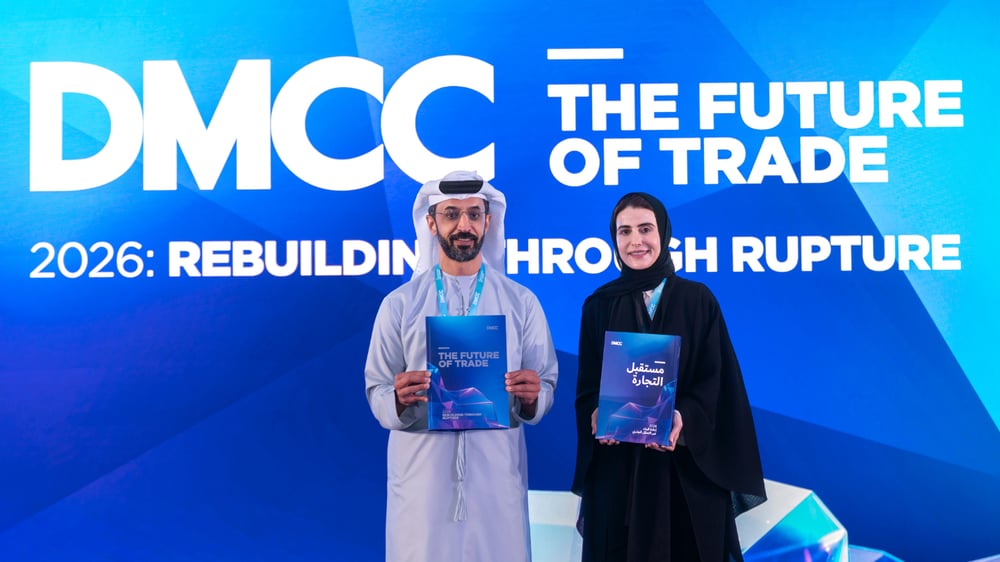
- DMCC Future of Trade 2026 report identifies UAE as key connector economy as South-South trade rises to 35% of global flows, outpacing North-North flows at 25%
- UAE positioned to capture next phase of AI-enabled trade, clean energy supply chains, digital payments and next-gen financial infrastructure
- UAE retains second place in DMCC Commodity Trade Index, reinforcing its position as one of the world’s leading commodities hubs
- Full Future of Trade report can be accessed at www.futureoftrade.com
DMCC, the leading international business district that drives the flow of global trade through Dubai, today launched its Future of Trade 2026 report in Dubai, finding that the UAE is set to play an outsized role in the next phase of global trade as businesses seek trusted connector economies that can help them navigate disruption, access high-growth markets and build resilience across key trade corridors.
Titled ‘Rebuilding Through Rupture’, the Future of Trade 2026 report finds that global trade will remain resilient over the next two years, but under a fundamentally different operating model shaped by AI at operational scale, structural tariff volatility, supply chains designed for resilience rather than cost efficiency, and an energy transition that has become a contest for industrial advantage. The report’s scenario analysis shows that businesses are planning for disruption as the baseline, with more than 80% of respondents expecting slow, uneven trade growth over the next one to three years and only 4% expecting the best-case scenario.
Growing South-South trade and rise of middle powers
The report finds that South-South trade now accounts for around 35% of global trade, surpassing North-North flows at around 25%, and shifting the geography of growth towards corridors linking Asia, the Middle East, Africa and Latin America. As part of a new "middle power" model reshaping global trade, the UAE is identified as a key connector economy combining strategic geography, advanced infrastructure, capital, commodities expertise and diversified trade relationships to support companies operating across multiple markets and trading systems. This positioning is already translating into capital flows: the report notes that the UAE ranked among the top five recipients of greenfield investment globally in 2024, evidence that investment is following economies able to operate credibly across blocs.
H.E. Dr Thani Bin Ahmed Al Zeyoudi, UAE Minister of Foreign Trade, said: "As the global trading system is reshaped by disruption, new corridors and the rapid rise of technology-enabled trade, businesses are increasingly seeking trusted, well-connected economies from which to navigate change and reach new markets. The UAE has anticipated these shifts through a long-term strategy built on openness, connectivity, diversification and investment in infrastructure, with our Comprehensive Economic Partnership Agreement programme expanding access to the world's high-growth markets. DMCC's Future of Trade report offers valuable insight into the forces redefining global commerce, and affirms the practical, forward-looking solutions that help businesses turn disruption into opportunity."
Ahmed Bin Sulayem, Executive Chairman and Chief Executive Officer, DMCC, said: “Our 2026 Future of Trade report shows clearly that the map of global trade is being redrawn. While growth is increasingly coming from the corridors connecting the Middle East, Asia, Africa, and Latin America, businesses are looking for places that can provide stability and help them navigate a more complex trading landscape. The UAE has spent decades building exactly that environment, combining world-class infrastructure, access to capital and commodities markets, and deep connections to the world’s fastest-growing economies. Today, that role is expanding further as artificial intelligence reshapes how trade is conducted, and as new financial infrastructure, from stablecoins to tokenised settlement systems, begins to transform how value moves across borders. Through Dubai and DMCC, businesses have a platform that allows them to access those opportunities, whether in commodities, supply chains, advanced technologies, or the next generation of trade finance.”
Feryal Ahmadi, Deputy CEO and Chief Operating Officer, DMCC, said: “The UAE's second place ranking in the 2026 Commodity Trade Index reflects the strengths that matter most to businesses when making long-term investment and trading decisions. At a time when costs are rising, supply chains are being reconfigured and volatility has become a permanent feature of the operating environment, companies increasingly place value in jurisdictions that offer predictability and the ability to operate across multiple markets with confidence. The UAE has established itself as one of those locations and its performance demonstrates the strength of the wider ecosystem supporting trade, from the regulatory environment and ease of doing business to the infrastructure and access to finance that enable companies to grow and expand internationally.”
UAE maintains second place in 2026 Commodity Trade Index
The UAE’s position as a connector economy is also reflected in DMCC’s 2026 Commodity Trade Index, where the UAE retains second place globally, behind only the United States. The report finds that the UAE offers the most competitive corporate tax regime of all ten leading commodities hubs assessed, and scores strongly across the institutional measures that increasingly determine where commodities trade is conducted, from regulatory quality and commodities endowment to geographic position and trade facilitation.
The report notes that the UAE’s continued performance in the Index comes despite heightened pressure on global energy and shipping routes, underlining the resilience of its commodities ecosystem. As energy security, logistics reliability and access to strategic resources become more important to trade competitiveness, the UAE’s role as a platform for commodities, capital and trade infrastructure is set to become even more central.
Rapid rise of AI trade growth
The report finds that AI-related goods have become one of the clearest sources of global trade growth, representing around 15% of global trade by volume but accounting for 43% of global trade growth in the first half of 2025. Trade across 100 AI-related product lines reached USD 1.92 trillion in the same period, up more than 20% year-on-year, compared with less than 4% growth in non-AI goods. However, the report warns that AI-enabled trade will depend on physical infrastructure as much as software adoption. Semiconductors, data centres, power grids, cooling systems, water, critical minerals, ports and logistics networks are becoming decisive factors in where AI capability can scale. The UAE’s position as an energy-secure, infrastructure-led and capital-rich trade hub places it in a strong position to capture this next phase of trade growth, particularly as companies seek reliable platforms for advanced manufacturing, digital services, commodities and cross-border investment.
UAE leads in building next-gen financial architecture
The report identifies the UAE as one of the frontrunners in building the next generation of financial infrastructure for trade. It is among a small group of jurisdictions alongside Singapore, Hong Kong and the UK that have introduced or are developing clear stablecoin regulatory frameworks, providing the certainty institutions need to adopt digital settlement at scale. The UAE is also a core participant in mBridge, the most significant wholesale central bank digital currency (CBDC) initiative underway. Tellingly, the report finds that the trade finance gap in the UAE is negligible, a reflection of the depth of its financial infrastructure and regulatory sophistication, at a time when the global gap remains stalled at USD 2.5 trillion.
Scaling a competitive position in the global energy transition
On the energy transition, the report describes a decisive shift from a climate agenda to a contest for industrial advantage and positions the UAE among the economies best placed to compete. It identifies the UAE as the most deliberate of the world's middle powers in building a role as a critical minerals hub, able to process minerals from producers and supply global markets without being locked into major power supply chains. The report points to UAE sovereign capital leading major investments across the value chain, with access to low-cost renewable and nuclear power giving the country a competitive edge in processing as costs rise elsewhere. The report frames this dual strength – deploying hydrocarbon revenues to build leadership in the new energy economy – as a defining feature of the Gulf's position, allowing the UAE to operate credibly across both the established and emerging energy orders and to act as an indispensable connector in clean technology supply chains.
Report launched in Dubai alongside government and industry leaders
DMCC unveiled the report in Dubai during a high-level event attended by senior government, trade and business leaders from across the UAE. The discussion examined what the report’s findings mean for the UAE’s long-term economic competitiveness, including the country’s role in strengthening resilient trade corridors, enabling AI-led growth and supporting the objectives of the Dubai Economic Agenda D33 through enhanced global connectivity, trade facilitation and business growth.
Future of Trade 2026 is DMCC’s biennial flagship research on the changing nature of global trade, now in its sixth edition and 10th year. The report draws on 12 roundtables with over 200 senior leaders, policymakers and trade experts across key global trade centres, alongside a survey of more than 130 businesses and trade practitioners. It examines the impact of global economic trends, geopolitics, technology, sustainability, trade finance and infrastructure on the future of the trade landscape, with recommendations for businesses and governments navigating a more fragmented and fast-moving global economy.
To read the full report by DMCC, please visit: www.futureoftrade.com